An Immigrant Parent’s Honest Review
When we moved to Portugal, I wasn’t sure what to expect from the public school system. Like many immigrant parents, I had my doubts. Would the academic level be good enough? Would my son adapt? Would the language barrier be a problem?
A few years later, I still don’t think the Portuguese public school system is perfect — no school system is. But there are several things that surprised me in a positive way, and I think other families researching a move here deserve an honest, specific account rather than a generic “it’s great” summary.
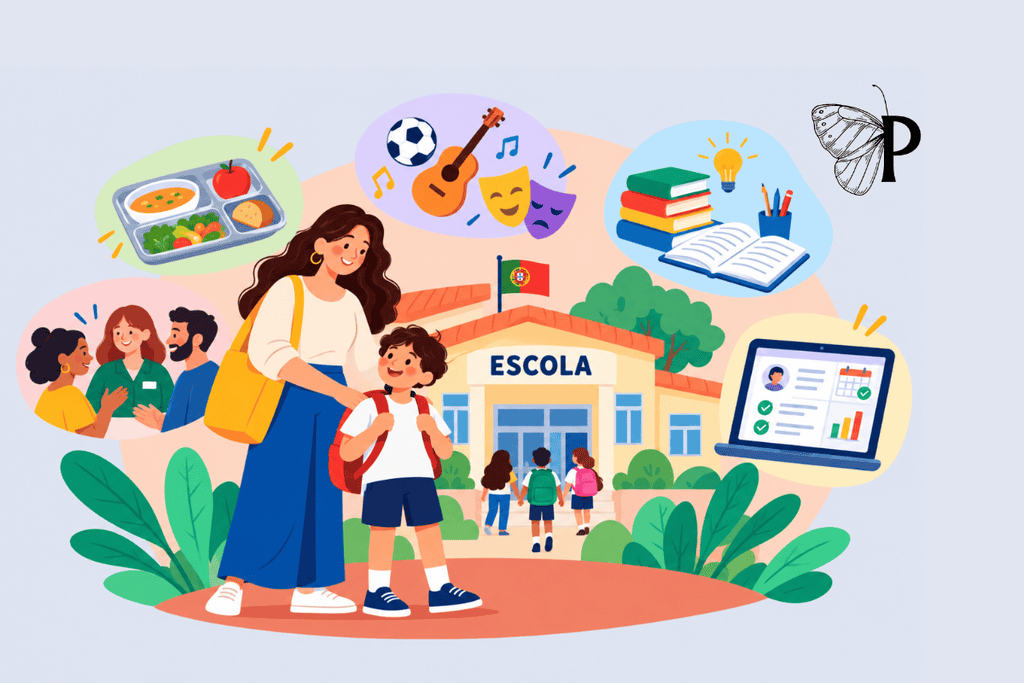
Here are five things I truly appreciate about public school in Portugal — based on our own experience in a small neighborhood school.
1. School Lunches and Snacks (Almoço Escolar)
This isn’t directly about education, but as a working parent, it has a huge impact on daily life.
Beyond the social importance of these meals — for some children, this may be the only hot meal they get all day — I appreciate them for a more selfish reason: they make my life easier. When you work a regular 9-to-6 schedule, the daily question of “what am I cooking today?” is exhausting. Knowing lunch is taken care of means I only need to think about dinner.
Are the meals amazing? Not necessarily. Could there be less rice and pasta? Probably. But they are freshly cooked meals that include soup, a main course (fish or meat), vegetables, and a side dish — balanced, and far better than most quick alternatives.
Then there are the snacks. One thing that genuinely surprised me: every classroom in my son’s school has a basket of seasonal fruit available daily (sometimes carrots, too), plus bread and milk. Some parents with fruit trees at home occasionally bring crates of oranges or pears to share with the class — a small detail that says a lot about the local culture.
For families receiving social support (Ação Social Escolar), school meals are free. For everyone else, the cost depends on household income but generally doesn’t exceed about €1.50 per meal.
2. Extracurricular Activities (AECs)
I know this is a controversial topic. I’ve heard plenty of parents complain about the Atividades de Enriquecimento Curricular (AECs) — teachers change, programs vary, and some schools clearly offer more than others. But in our case, the experience has been positive.
My son has around five hours per week of activities including sports, music, and theatre. Many of these happen outdoors, which I appreciate in a world where children already spend too much time sitting.
3. A More Flexible Curriculum
This is the most subjective point on this list, and I can only speak from our experience in the primary school cycle (1º ciclo).
What surprised me is that the curriculum doesn’t feel completely rigid. Teachers seem to have real autonomy in how they organize lessons, and they have access to continuous training to keep adapting their methods.
There are mandatory national assessments, of course, but the pressure feels different than what I experienced growing up in Eastern Europe. It feels less focused on penalizing the child and more on evaluating teaching outcomes.
Tip for immigrant families: children who don’t speak Portuguese are entitled to study it as a non-native language (PLNM — Português Língua Não Materna). Many schools also offer extra language support groups to help kids integrate before joining regular classes.
4. The Community Built Around the School
This is my favorite thing on this entire list.
The parenting culture here isn’t the anxious, hyper-competitive environment I’ve encountered elsewhere — it’s more relaxed, collaborative, and human. Parents show up. They volunteer, organize birthday parties, and help out even when the child involved isn’t their own.
For immigrant families, this matters more than people realize. A school isn’t just where your child learns — it’s often where your family builds its first local network. Many of our closest friendships in Portugal started right at the school gates.
5. You Can Do Almost Everything Online
Portugal has a reputation for bureaucracy, but school administration has genuinely surprised me — it’s remarkably digital.
Through platforms like GIAE or Inovar, you can check attendance, view grades, and top up your account to pay for meals. School enrollment itself is centralized online through the Portal das Matrículas. You rarely need to physically visit the school for admin tasks — a real time-saver for working parents.
Is public school in Portugal perfect? No. There are funding challenges, teacher shortages, and real differences between schools — our experience is from one small neighborhood school, not a national guarantee.
But looking at the big picture — affordable hot lunches, free fruit, municipal sports programs, a welcoming parent community, and streamlined online admin — our experience has been far more positive than we expected.
FAQ
Is public school free in Portugal for foreigners?
Yes. Public school is free for all resident children in Portugal, including foreign nationals, regardless of immigration status. Families may still pay small fees for meals (subsidized based on income) and school materials.
Do Portuguese public schools teach in English?
No, instruction is in Portuguese. Children who don’t speak the language can access PLNM (Portuguese as a Non-Native Language) support, and many schools with larger immigrant populations offer additional language groups.
How much does school lunch cost in Portugal?
Typically up to about €1.50 per meal for families not receiving social support; it’s free for families enrolled in Ação Social Escolar based on household income.
How do I enroll my child in a Portuguese public school?
Enrollment is done online through the Portal das Matrículas
Another pleasant surprise is municipal involvement. Every year, the local council (Câmara Municipal) provides transportation so children can take part in sports activities outside the school grounds. For two years running, my son’s class went to a proper athletics track, and I know other schools that organize weekly swimming sessions.